Optiver Interview Process for Software Engineers
What to expect interviewing at Optiver as a SWE, contributed by a Jane Street Software Engineer that also received an offer from Optiver. This SWE is a member of the getcracked.io community.
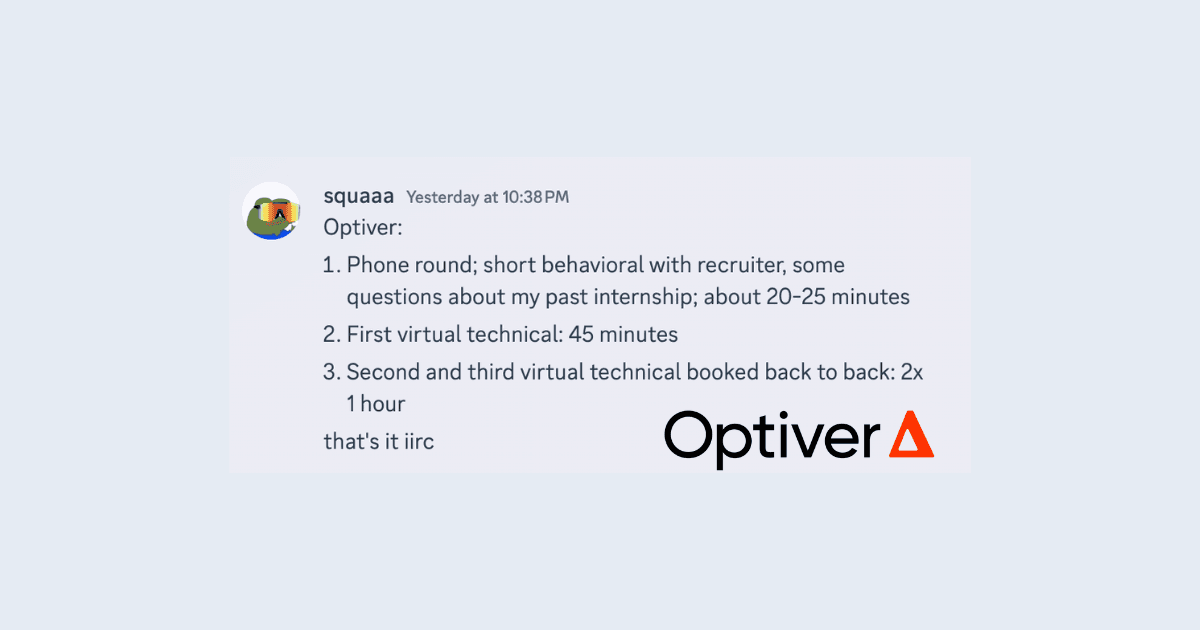
The Optiver Interview (SWE)
Overview
The following article is based on a discussion with a Jane Street SWE who also received an offer from Optiver after becoming a getcracked.io member.
The Optiver Software Engineering interview is structured, fast-paced, and heavily focused on technical execution and problem solving.
Compared to firms like Jane Street, Optiver leans more toward:
Classic technical interviews (DSA-heavy)
Consistent evaluation across rounds
Clear progression in difficulty
The process is typically front-loaded with multiple technical rounds, often scheduled close together.
Interview Process Breakdown
Stage 1: Recruiter Screen
Format
~20–25 minutes
Short behavioral + resume walkthrough
What to Expect
Questions about:
Past internships
Technical projects
Motivation for Optiver
Typical Questions
“Tell me about your previous internship”
“Why Optiver?”
“What kind of work are you looking for?”
Goal
Basic signal check (communication + background), ensuring you aren't crazy
No deep technical evaluation
Stage 2: First Technical Interview
Format
~45 minutes
Fully technical
What to Expect
One or two coding problems
Standard data structures & algorithms focus
Common Topics
Arrays / strings
Hash maps
Basic graph / traversal
Implementation-heavy problems
Key Insight
This round is used to filter for baseline coding ability and clarity of thought.
Stage 3: Second & Third Technical Interviews
These are typically scheduled back-to-back, making this the most intense part of the process.
Format
2 × 60-minute interviews
Fully technical
Same day
Stage 3.1: Technical Interview #2
What to Expect
More complex problem than round 1
Multi-step solution
Edge cases and optimizations
Focus Areas
Algorithmic depth
Code quality
Handling constraints
Stage 3.2: Technical Interview #3
What to Expect
Highest difficulty in the process
May involve:
Multiple subproblems
Systematic exploration of approaches
Performance tradeoffs
Focus Areas
Problem decomposition
Efficiency (time/space)
Ability to recover if stuck
Unlock members-only posts
Sign up free to read members-only posts in full.