Optiver Interview Process for Quant Researchers
What to expect interviewing at Optiver as a Researcher, contributed by an Optiver Quant Researcher who is both a coach and a member of the getcracked.io community. This researcher is a member of the getcracked.io community.
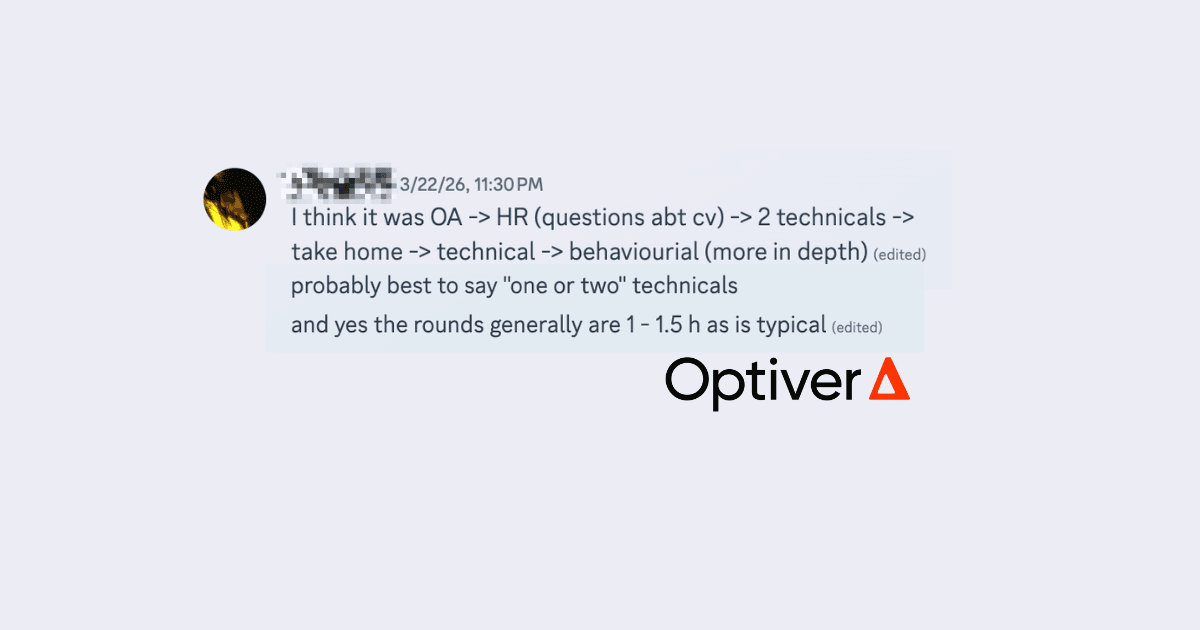
The following breakdown is based on a first-hand account from a Quant Researcher (and coach) in the getcracked.io community. While exact details may vary slightly by office and seniority, the overall structure is consistent: a multi-stage process that emphasizes both technical depth and practical research ability.
Overview
The Optiver Quant Researcher interview process can be summarized as:
OA → HR → Technicals → Take-Home → Technical → Behavioural
Each stage builds progressively, with increasing emphasis on real-world research thinking and depth of understanding. Interview rounds are typically 1 to 1.5 hours long, which is slightly longer than standard for top-tier quant firms (averaging around 45 to 60 minutes).
Stage 1: Online Assessment (OA)
The process begins with an online assessment designed to evaluate core quantitative ability.
Typical components include:
Probability and statistics problems
Logical reasoning and pattern recognition
Mental math under time pressure
This stage is highly time-constrained and requires both accuracy and speed.
What they’re testing:
Raw quantitative ability
Comfort with probabilistic thinking
Ability to perform under pressure
Stage 2: HR Interview
After passing the OA, candidates move to an HR screen.
This stage focuses on:
Your background and CV
Interest in quant research and trading
Communication skills
While lighter technically, strong candidates are expected to clearly articulate their past work and motivations.
What they’re testing:
Communication clarity
Motivation for the role
Cultural alignment
Vibe check - in other words, making sure you're not crazy.
Stage 3: Technical Interviews (1–2 Rounds)
Candidates typically go through one or two technical interviews, depending on performance.
Topics commonly include:
Probability and statistics
Brainteasers and expectation problems
Coding (often Python or C++)
Quantitative reasoning
These rounds often blend:
Structured problem solving
Open-ended reasoning
Discussion of approaches
What they’re testing:
Mathematical intuition
Problem-solving ability
Coding fluency
Stage 4: Take-Home Assignment
A key component of the process is the take-home project.
This stage typically involves:
Analyzing a dataset
Building a model or signal
Producing a structured write-up
Compared to interviews, this is much closer to the actual day-to-day work of a Quant Researcher.
What they’re testing:
Research workflow
Data analysis and modeling
Ability to extract signal from noise
Stage 5: Technical Deep Dive
Following the take-home, candidates return for a technical deep dive.
This round often includes:
Presenting your take-home work
Defending your methodology
Exploring improvements and alternatives
Interviewers may challenge:
Your assumptions
Model robustness
Edge cases and failure modes
What they’re testing:
Depth of understanding
Ability to defend decisions
Research rigor
Stage 6: Behavioural (In-Depth)
The final stage is a more detailed behavioural interview.
This goes beyond standard questions and focuses on:
Decision-making under uncertainty
Handling failure in research
Collaboration with teammates
Expect to discuss:
Past projects in depth
Trade-offs you made
Lessons learned
What they’re testing:
Ownership and accountability
Intellectual honesty
Team fit
Final Thoughts
The quantitative research position is hard to crack, but lucrative once you make it. If you're interested in ensuring that you nail every stage of the process, you can book a coach right here on getcracked.io via this link.
Unlock members-only posts
Sign up free to read members-only posts in full.