Voleon Interview Process for Software Engineers (C++)
What to expect interviewing at Voleon as a senior SWE, contributed by a Voleon Software Engineer that writes code in C++. This SWE is a member of the getcracked.io community.
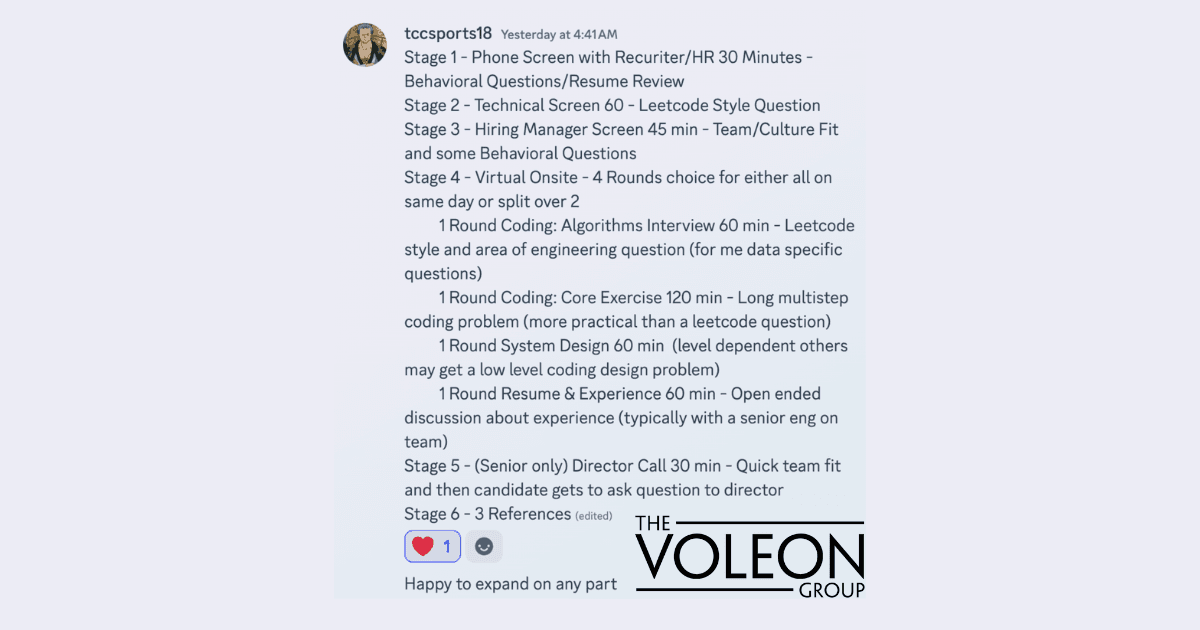
Voleon Senior Software Engineer (C++) Interview Process
The following breakdown is based on a first-hand account from a Senior Software Engineer candidate in the getcracked.io community. While exact details may vary slightly by team and level, this reflects a rigorous, multi-stage process focused on deep technical ability, system design, and real-world engineering execution.
Overview
The Voleon Senior Software Engineer interview process can be summarized as:
HR Screen → Technical Screen → Hiring Manager → Onsite (4 Rounds) → Director (Senior Only) → References
The process is intentionally comprehensive, evaluating candidates across algorithms, systems, practical coding, and experience depth.
Stage 1: Recruiter / HR Screen (~30 Minutes)
The process begins with a phone screen with a recruiter or HR representative.
This stage covers:
Resume walkthrough
Behavioral questions
General background and experience
It is a standard screening step, but candidates should still be prepared to clearly articulate their technical impact and prior work, especially in C++ systems.
What they’re testing:
Communication clarity
Career narrative
Alignment with the role
Stage 2: Technical Screen (~60 Minutes)
The next step is a technical phone screen, typically centered around a LeetCode-style problem.
Key characteristics:
Algorithmic problem solving
Emphasis on correctness and efficiency
Implementation in a live coding setting
While this round is more traditional, strong candidates are expected to demonstrate clean, efficient C++ code and strong problem-solving fundamentals.
What they’re testing:
Data structures and algorithms
Coding fluency in C++
Ability to reason under time pressure
Stage 3: Hiring Manager Screen (~45 Minutes)
Candidates then meet with the Hiring Manager.
This round focuses on:
Team and culture fit
Behavioral questions
Discussion of past experience
There may also be some light technical discussion, but the emphasis is on whether you would fit well within the team and contribute effectively at a senior level.
What they’re testing:
Leadership and ownership
Communication and collaboration
Alignment with team goals
Stage 4: Virtual Onsite (4 Rounds)
The core of the process is a virtual onsite consisting of 4 rounds, which can be scheduled either in a single day or split across two days.
Algorithms Coding → Core Coding Exercise → System Design → Resume Deep Dive
Each round is long-form and designed to probe both depth and real-world engineering ability.
Algorithms Coding (~60 Minutes)
This round focuses on:
LeetCode-style problems
Algorithmic reasoning
Possibly domain-specific twists (e.g., data-focused problems)
Candidates are expected to:
Write correct and efficient solutions
Clearly explain their approach
Handle edge cases
What they’re testing:
Strong fundamentals
Problem-solving clarity
Clean C++ implementation
Core Coding Exercise (~120 Minutes)
This is one of the most distinctive parts of the process.
Key characteristics:
Long, multi-step problem
More practical than typical LeetCode questions
Requires sustained focus and execution
This round simulates real-world engineering tasks and often involves:
Designing and implementing a system or component
Handling multiple constraints and requirements
Writing production-quality code
What they’re testing:
Real-world coding ability
Systematic problem solving
Code quality and completeness
System Design (~60 Minutes)
Candidates are asked to design a system, with expectations depending on level.
Focus areas include:
Architecture and scalability
Trade-offs and constraints
Performance considerations
For some candidates, this may lean toward:
High-level distributed systems
Or lower-level system design problems
What they’re testing:
Systems thinking
Ability to design under constraints
Senior-level engineering judgment
Resume & Experience Deep Dive (~60 Minutes)
This is an open-ended discussion with a senior engineer focused on your past work.
You may be asked to:
Walk through complex projects
Explain design decisions and trade-offs
Discuss challenges and failures
Expect deep probing—this is not a surface-level resume review.
What they’re testing:
Depth of experience
Ownership and impact
Ability to communicate complex systems
Stage 5: Director Call (Senior Candidates Only, ~30 Minutes)
Senior candidates may have an additional Director-level interview.
This is a shorter conversation focused on:
High-level team fit
Career trajectory
Candidate questions
It’s also an opportunity for you to evaluate the team and leadership.
What they’re testing:
Senior-level alignment
Leadership presence
Long-term fit
Stage 6: References
The final step is a reference check, typically requiring three references.
This stage validates:
Past performance
Collaboration and teamwork
Technical and professional reputation
Final Thoughts
The quantitative research position is hard to crack, but lucrative once you make it. If you're interested in ensuring that you nail every stage of the process, you can book a coach right here on getcracked.io via this link.
Unlock members-only posts
Sign up free to read members-only posts in full.