How Many Hours Does It Actually Take to Become a Quant Developer?
The honest, itemized breakdown from a blank resume to a signed offer. It's over a thousand hours, and almost all of it is one thing.
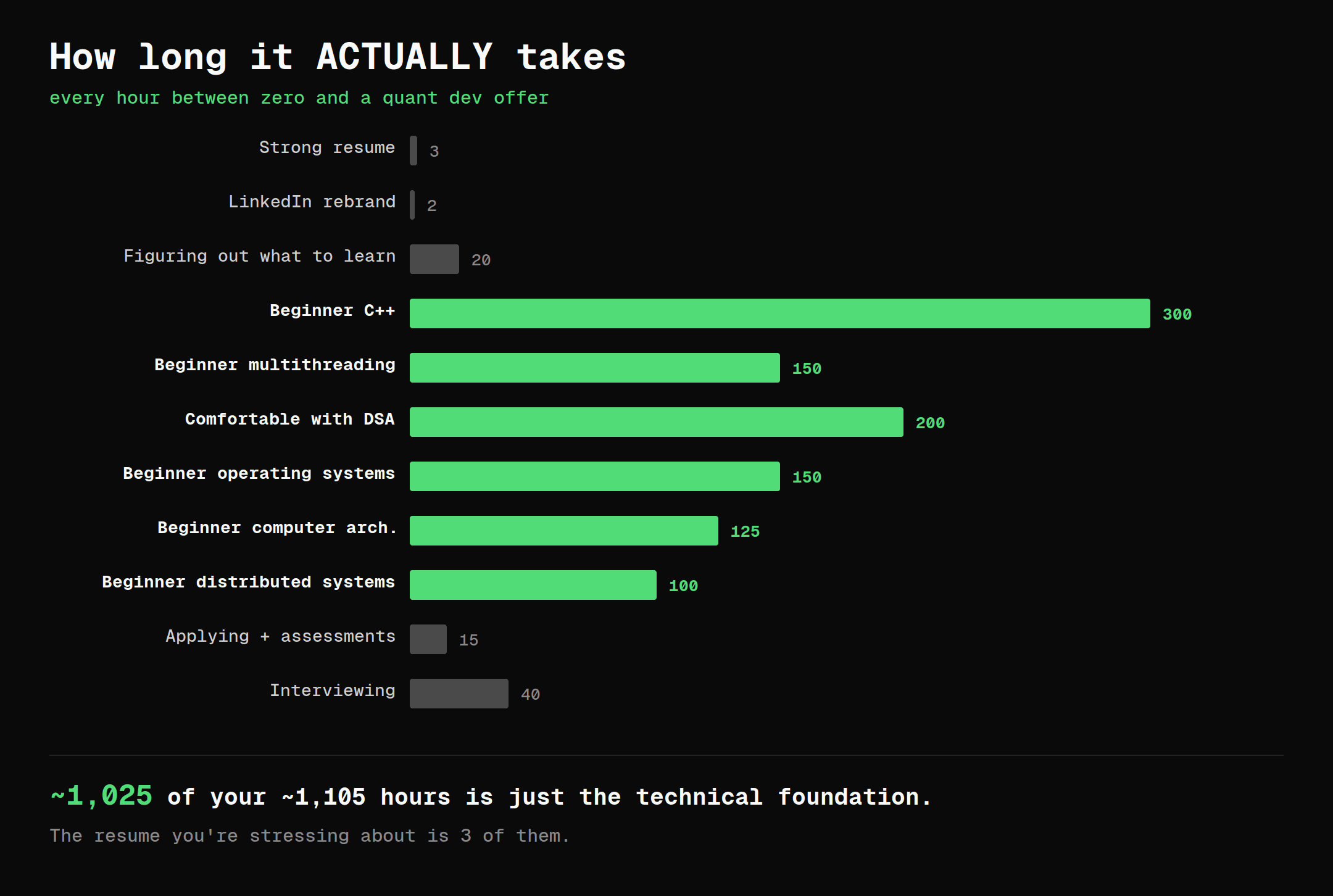
Everyone wants the timeline and nobody wants the real one. So here it is, itemized, no rounding down to make you feel better. This is roughly what it takes to go from zero to a quant developer offer, hour by hour.
Step | Hours |
|---|---|
Strong resume | 3 |
LinkedIn rebrand | 2 |
Figuring out what to even learn | 20 |
Beginner C++ | 300 |
Beginner multithreading | 150 |
Comfortable with DSA | 200 |
Beginner operating systems | 150 |
Beginner computer architecture | 125 |
Beginner distributed systems | 100 |
Applying and online assessments | 15 |
Interviewing | 40 |
The setup: about 25 hours
Three hours on a strong resume. Two on a LinkedIn rebrand. Then twenty on the least glamorous line in the whole list: figuring out what you actually need to learn in the first place.
That last one sounds like nothing until you've spent a month bouncing between conflicting roadmaps. Twenty hours of orientation up front is cheap insurance against hundreds of hours spent pointed at the wrong thing.
The actual mountain: about 1,025 hours
This is where the timeline really lives. Not the resume. Not the interview prep. The foundation.
- 300 hours to get proficient at beginner C++
- 150 for beginner multithreading
- 200 to get comfortable with data structures and algorithms
- 150 for beginner operating systems
- 125 for beginner computer architecture
- 100 for beginner distributed systems
Every single one of those says beginner, and together they're still over a thousand hours. You are not cramming leetcode patterns here. You are building the actual body of knowledge the job runs on, and there is no version of this where that part is quick.
And pay attention to the word carrying that whole list: beginner. Beginner C++ in a quant context does not mean you can write a for loop. It means you understand memory, templates, and where your performance actually goes, because that is the language the job is written in. The same is true down the line. Operating systems and computer architecture matter here in a way they never do for someone building web forms, because a huge part of the job is making code fast on real hardware. These fundamentals aren't box-checking on the way to the role. They are the role.
Getting the offer: about 55 hours
Fifteen hours of applying and grinding through online assessments, then forty hours of interviewing before you sign. Look at how small that is next to the learning. The job hunt isn't where the time goes. It's the tollbooth at the end of the road, not the road itself.
So what's the real number?
North of a thousand hours from a cold start. And here's the part worth sitting with: roughly ninety percent of it is the technical foundation. The resume, the LinkedIn, the applications, the interview reps, all the stuff people burn their energy stressing about, is a rounding error next to the time you spend actually learning the material.
That's oddly good news. It means the single highest-leverage move available to you is making the learning faster, because that is where almost all of your time is going to go.
A thousand hours also sounds a lot worse than it is, because it's finite and it's mapped. Most people who wash out of this don't fail because the hours were too many. They fail because they spent six months half-learning five things at once, never sure if they were even working on the right thing. That is exactly why the least glamorous line on the list, the twenty hours spent figuring out what to learn, is quietly the most important one. It's also the problem our progress trees exist to kill: a concept-by-concept map of exactly what to learn, and in what order, to crack quant, so none of your thousand hours get spent guessing. Point them in the right direction and the number stops being scary and starts being a plan.
Cutting the number down
That is the entire point of getcracked.io. It's built to cut these times down by roughly half, so a thousand-hour climb turns into something you can actually finish while still having a life.
And if you want the resume and the LinkedIn handled for you outright, with everything else cut by around seventy-five percent, that's what we're building with GetCracked Elite, our upcoming placement accelerator. More on that soon.
Unlock members-only posts
Sign up free to read members-only posts in full.