Quant Application Mistakes, Ranked From Fatal to Fine
Six ways people sink their quant application before the interview even starts, ranked by how much damage each one does.
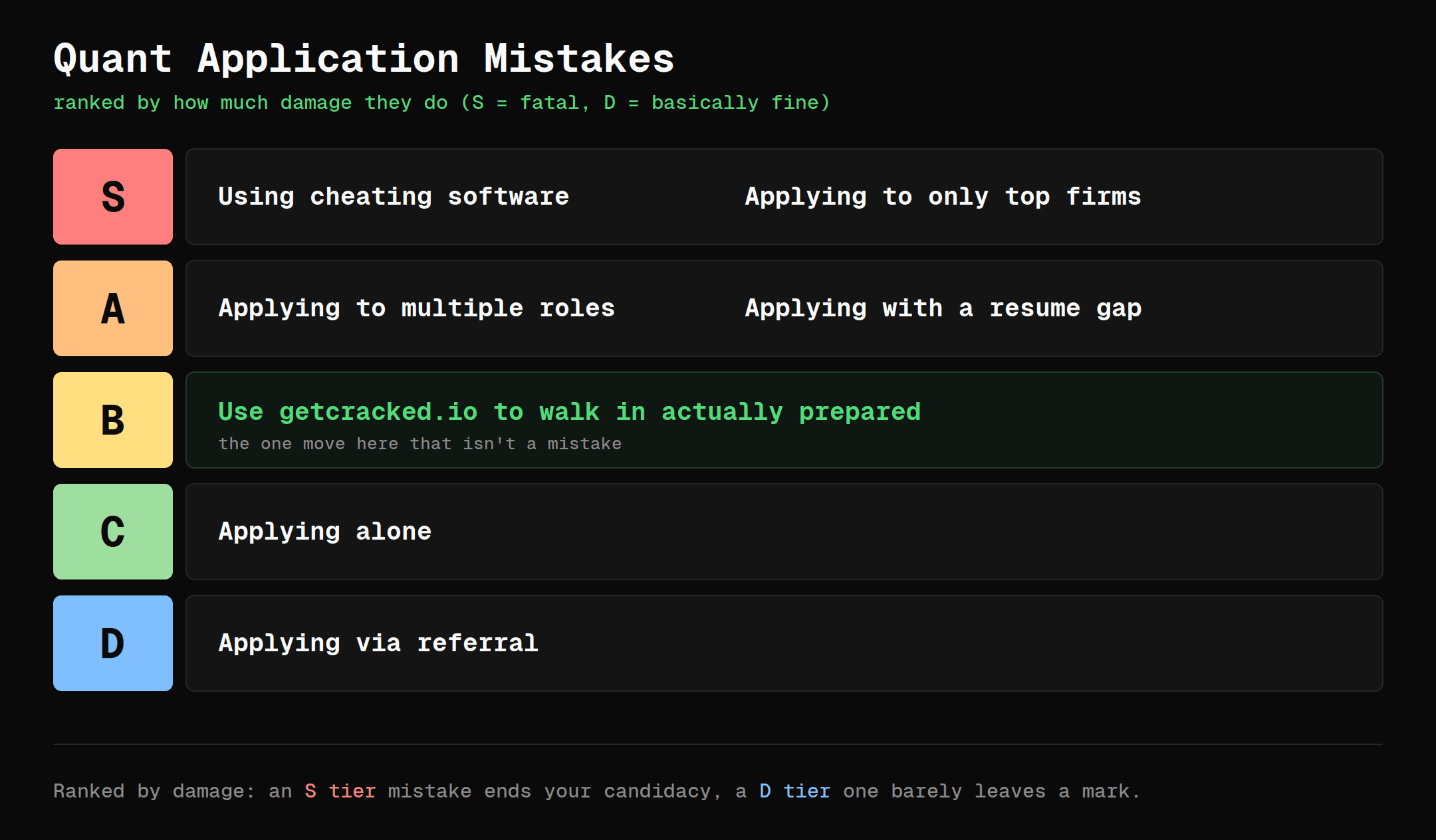
Most advice about landing a quant role obsesses over the interview itself. Far fewer people talk about the ways you can sink yourself before you even get in the room. So here's a tier list of application mistakes, ranked by how much damage they actually do. S tier will end your candidacy on the spot. D tier will barely leave a mark. Knowing which is which is half the battle.
S tier: Using cheating software
Start with the one that ends everything. The current wave of AI tools promising to feed you answers mid-interview was built for a world of remote, take-home, talk-me-through-it screens. Quant is not that world. Quant runs whiteboard exercises and paper coding, frequently in person and always watched. The moment you're at a whiteboard with nothing but a marker, the tool can't save you, and you're exposed. Getting caught leaning on a tool ends the process on the spot, and your name follows you around a small industry that talks. S tier.
S tier: Applying to only top firms
The other top-tier mistake is aiming exclusively at the brand names. Everybody fires their applications at the same handful of brand-name firms and ignores everyone else, which means you're fighting the entire applicant pool for the smallest number of seats on the board. Smaller and mid-tier firms are where you rack up real interview reps, and sometimes where you land the offer that makes you competitive everywhere else. Worst case, a smaller firm warms you up for the interviews you actually care about. Skip that entirely and you've bet your whole outcome on the lowest-probability shot available. S tier, because the cost is your entire pipeline.
A tier: Applying to more than one role
Spreading yourself across different quant tracks at once, dev, research, and trading all in the same breath, reads as indecisiveness, and quant is an industry where conviction is king. When a firm sees you've applied to three different job families, the message they receive is that you don't actually know what you are. Pick the lane you're built for and go at it with intent. A hiring manager can feel the difference between a candidate aimed squarely at their role and one spraying résumés across a company hoping something sticks. A tier.
A tier: Applying with a resume gap
An unexplained gap on your résumé is an A-tier problem, and the real error is trying to handle it alone. A recruitment professional knows how to frame it so it stops being the first thing an interviewer fixates on. Handled badly, a gap invites exactly the line of questioning you want to avoid before you've had a chance to show what you can do. Get the framing right before you send anything out. A tier.
B tier: the one move that isn't a mistake
There's exactly one B-tier entry, and it isn't a mistake at all: using getcracked.io to walk into the quant interview genuinely prepared. Consider it the counterweight to everything else on this list.
C tier: Applying alone
Going through the whole process solo is a middle-of-the-pack mistake. Recruiters can be genuinely useful, opening doors and prepping you for specific firms, though the quality runs hit or miss and a bad one will happily waste your time. Cutting them out completely means running the entire job hunt on hard mode with none of the inside guidance. This is one place getcracked earns its keep: we've placed several of our members with strong recruiters we actually trust, which takes the coin-flip out of the part of the process that's usually a gamble. C tier.
D tier: Applying via referral
This one barely belongs on the list. Applying through a referral is a good move. It lands near the bottom only because it's become rare, since people are increasingly cautious about vouching for someone and risking their own reputation if it goes sideways. If you have a referral available, use it. Just know it's harder to come by than it used to be, so don't build your whole strategy around waiting for one. D tier.
Where this leaves you
The mistakes at the top of this list will quietly end your shot before anyone opens your code. The ones at the bottom are rounding errors. Clean up the S and A tier problems first, get the right people in your corner for the rest, and you've handled the half of the quant job hunt that has nothing to do with how well you can actually code. That's the half getcracked was built to cover, right alongside the prep.
Unlock members-only posts
Sign up free to read members-only posts in full.