Your LeetCode Grind Means (Almost) Nothing at a Prop Shop
A candidate cleared four Akuna rounds and still got cut. Here's what quant dev interviews actually test, and why LeetCode isn't it.
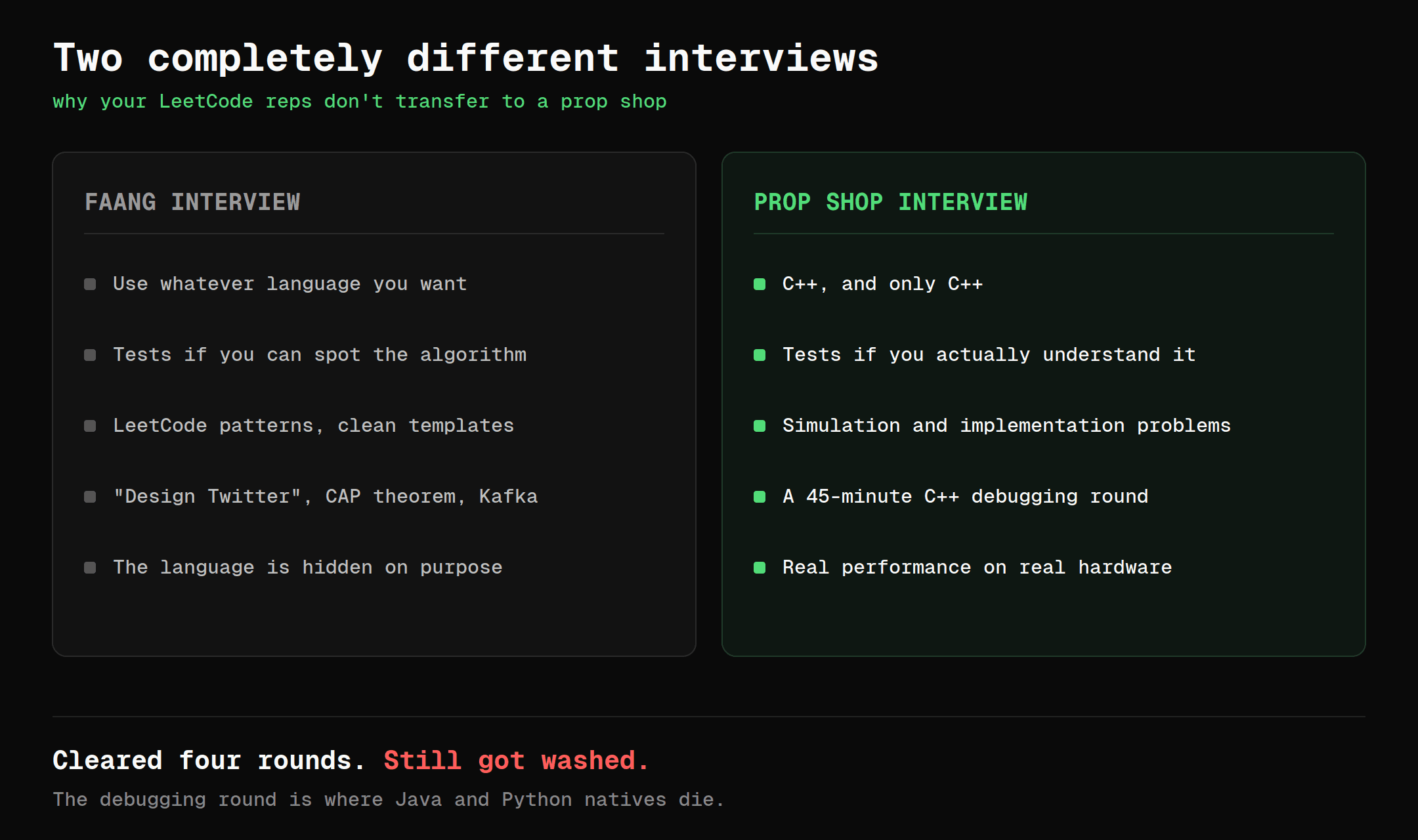
Someone posted their full Akuna Capital software engineer loop on r/leetcode this week. C++ role, new grad, Chicago office. Read it if you still think grinding 500 Blind problems is a moat, because this candidate cleared four technical rounds and still got washed out before the final.
Here's what actually stood out, and it's largely why I built getcracked.io in the first place.
The OA isn't LeetCode
The first round was a HackerRank OA with three problems, all of them heavy on simulation and implementation. Forget the tidy pattern-matching you've drilled a thousand times. There's no clean two-pointer template to reach for. The whole point is to see whether you can build something that follows a set of rules and keeps running, which takes a completely different muscle from recognizing that a problem is "just" a sliding window.
If your prep is one hundred percent pattern recognition, this is the first place the floor gives out
The C++ debugging round FAANG doesn't have
Then there's a 45-minute debugging round: a codebase seeded with bugs, and your job is to find and fix all of them before the clock runs out. FAANG has nothing that looks like this.
This is exactly where the candidate got into trouble, and it's worth understanding why. By their own admission, they mostly write Java. The codebase is C++. If you can't look at code you didn't write and reason about a dangling reference or undefined behavior on sight, you are not fixing those bugs in 45 minutes. Reading and repairing unfamiliar C++ under a clock is a specific skill, and it does not come free with a LeetCode streak.
This is the same reason I grill people during call-ins. If you can't hold it together debugging with an ex-quant dev while you're anonymous and the stakes are fake, you're not going to hold it together in a camera-on round with a real offer on the line.
The language is the test
Look at the topics the candidate listed across their rounds: advanced STL, memory management, pointers versus references, concurrency, low-level optimization, networking. Every single item on that list is a question about C++ itself.
This is the opposite of how FAANG runs interviews. FAANG hides the language on purpose. You use whatever you're comfortable with, because they're testing whether you can find the algorithm. A shop like Akuna does the reverse. They want to know whether you actually understand the tool. Do you know what your std::vector does when it reallocates, or do you just call push_back and hope? At this level, "I use C++" and "I understand C++" are two entirely different interviews, and only one of them passes.
No system-design theater
There's also no system-design cosplay here. Nobody asks you to "design Twitter" or wave your hands at the CAP theorem while name-dropping Kafka. The system-level discussion is concrete: real performance, real code, real hardware. The boxes-and-arrows theater simply never comes up.
That distinction is a big part of why I've already put two videos on getcracked into exactly this, performance and real system design, while everyone else is still rehearsing for the whiteboard.
Where the Java and Python natives die
If you're coming from Java or Python and eyeing quant dev, the debugging round is where this process is most likely to end for you, and it'll end fast. This candidate proved it: sharp enough to clear four rounds, and still stopped cold by C++ under pressure. Respect to them for going all-out and posting the whole thing, that writeup is more useful than most prep advice you'll pay for.
More LeetCode isn't the fix. Quant dev interviews are measuring whether you actually know the language and can work in it when things get messy, and closing that gap is exactly what I built getcracked for.
Source
Akuna Capital Software Engineer (C++) interview experience, new grad, Chicago office. Posted on r/leetcode. https://www.reddit.com/r/leetcode/comments/1tsw5x6/akuna_capital_software_engineer_c_interview/
Unlock members-only posts
Sign up free to read members-only posts in full.